ShortCol — Analysis of Reinforced Concrete Members
- Axial
- Bending
- Shear
- Torsion
- Crack Control
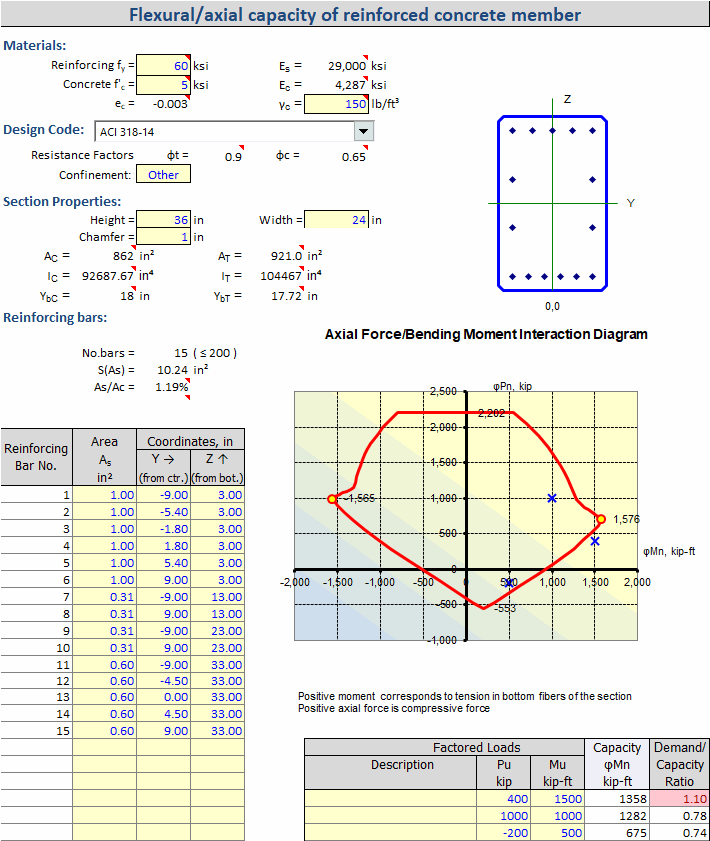
ShortCol provides a complete solution for reinforced concrete members subjected to combined loading demands. It performs strain-compatibility analysis to compute internal forces and determine member resistance, with all design checks strictly following code-prescribed equations. Suitable for building and bridge projects, it supports US, Canadian, and Australian concrete design codes. Designed for productivity, it features a clean, intuitive interface with attractive visuals. All algorithms are rigorously verified and fully documented in the accompanying Verification Manual and Mathcad Algorithm.
Key Features
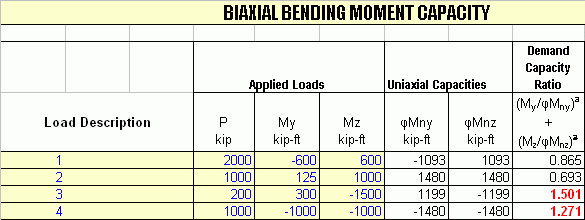
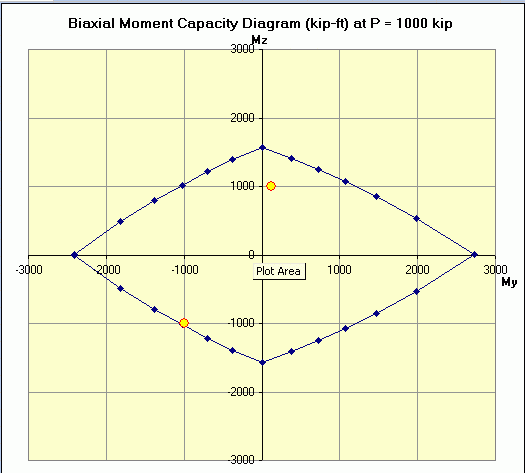
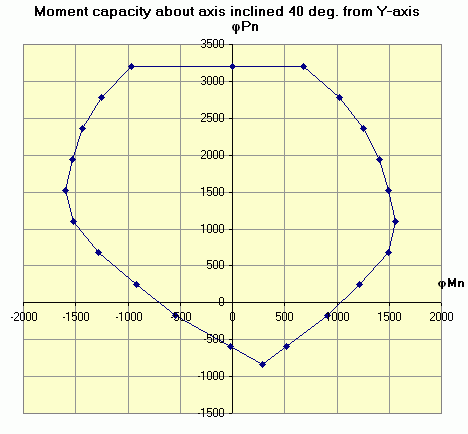
- Generates uniaxial and biaxial P-M interaction diagrams
- Evaluates stresses in reinforcing steel and concrete crack width under service loads
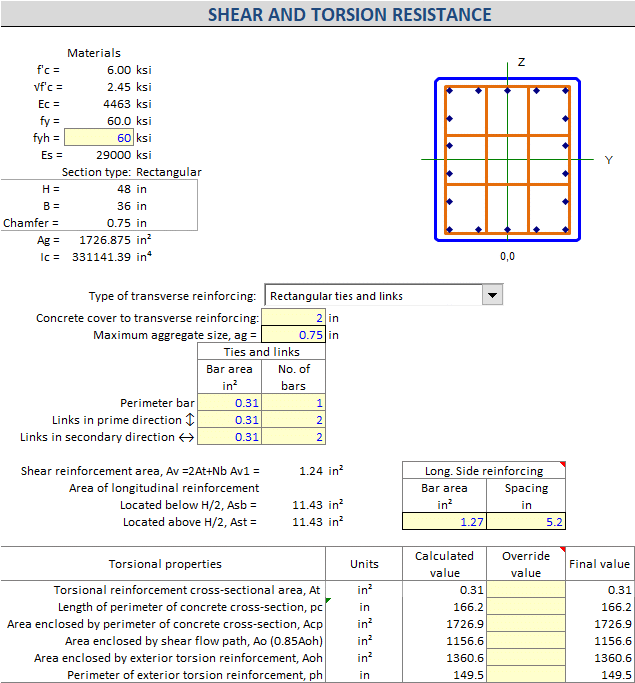
- Calculates shear and torsion resistance
- Computes cracked section moment of inertia for deflection analysis
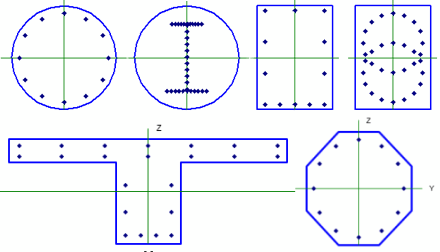
- Supports circular, rectangular, chamfered, and T-beam cross-sections
- Allows quick definition of standard or irregular reinforcement layouts
- Supports US Customary and SI units
Supported Design Codes
- ACI 318-25 (US building)
- AASHTO LRFD 10th Edition, 2024 (US bridge)
- AS 3600-2018 (Australian building)
- AS 5100.5-2017 (Australian bridge)
- CSA A23.3-14 (Canadian building)
- CSA S6-19 (Canadian bridge)
What's New in Version 2026.04
- Updated to ACI 318-25 and AASHTO LRFD 10th Edition, 2024
- Factored and nominal P-M interaction diagrams now displayed together on one graph
- Outputs key control points on P-M diagram: pure axial, pure bending, balanced, and zero-tension
- Restructured internal calculations for more robust and faster performance
- Refined output formatting for a clean, one-page results summary
Ease of Use
- Change section type and reinforcing layout in seconds
- Instant analysis results with optimized computation
- All essential outputs consolidated on a single page for easy report integration
Limitations
- Slenderness (buckling) effects are not included
- Biaxial bending strength is approximated via principal-axis interaction formulas
- Maximum of 200 reinforcing bars per section
- Prestressed and unbonded reinforcement are not supported
- Concrete stress is modeled with a rectangular block at ULS and a linear distribution at SLS
Sample Screenshots